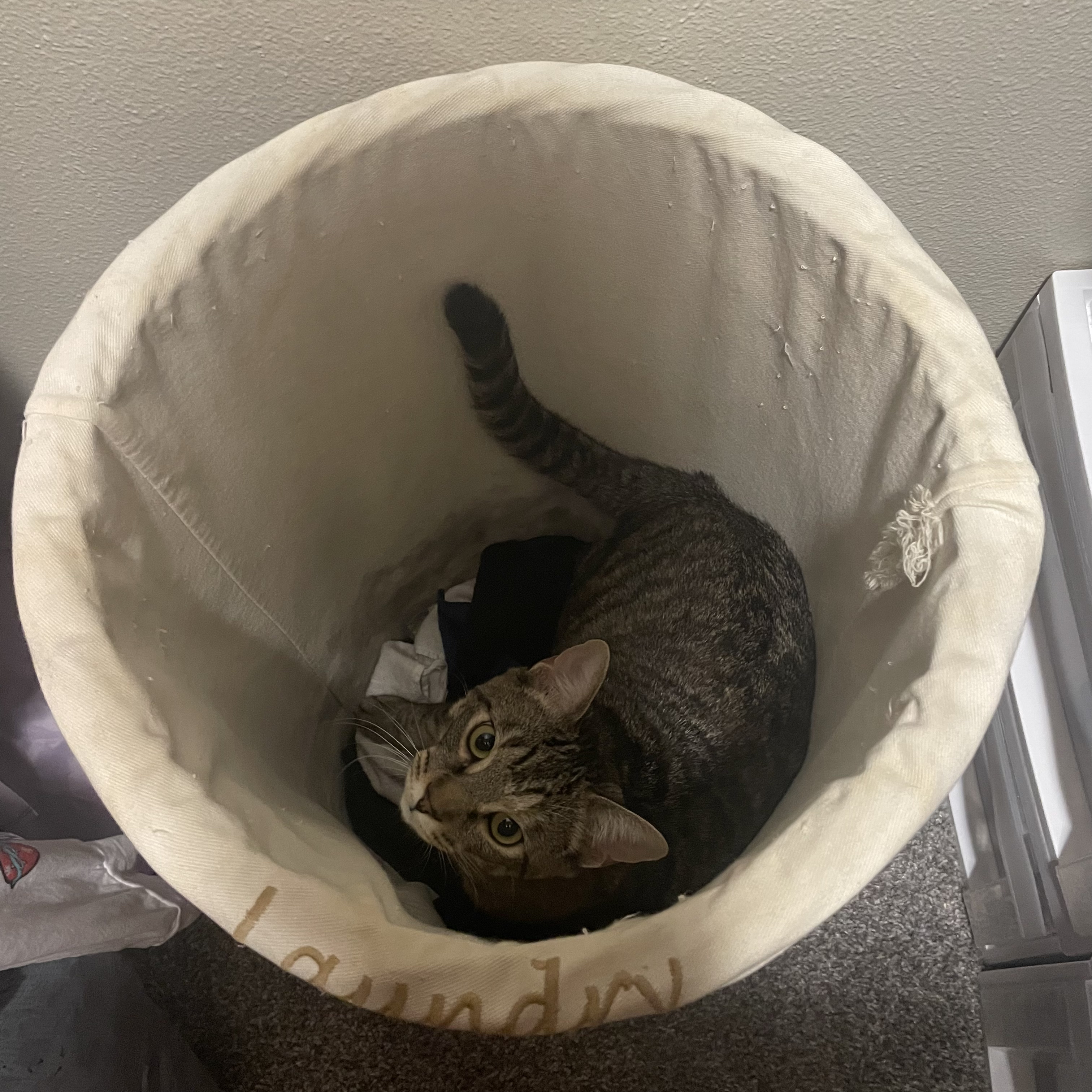
Conflicted or Stressed 🙀Behaviors of a Cat 🐱
When your cat is feeling uneasy, unsure about what to do, or dealing with stress, you might notice these behaviors.
Look Away, Head Turn
Often misinterpreted as being aloof or antisocial.
Visual Signs
Avoids eye contact or turns head away from source of stress.
Head may also dip down briefly, like a nod.
What Your Cat May Be Feeling or Doing
Uneasy
“I need some space.”
Wanting to politely interrupt or end an interaction.
“Not now, thank you.”
Nose Lick
Visual Signs
Quick lick of the lip or nose followed by swallowing (not to be confused with licking lips are eating).
What Your Cat May Be Feeling
Uneasy; Concerned
Put on the spot.
Needing to reduce tension.
Stress Grooming or Scratching
Self-grooming is a normal cat activity usually done after a meal and before settling down for a nap. Stress grooming is an example of a behavior done out of the usual context due to anxiety or conflict.
Visual Signs
Suddenly licking themselves while in the middle doing something else.
Usually, a few quick licks on the side of the leg or body, or at base of the tail.
What Your Cat May Be Feeling
Anxious
Uncertain about the situation.
Needing to release tension.
Needing to focus on something else.
*Note: Prolonged grooming in one area of the body may be a sign of pain or discomfort, especially if your notice redness or bald spots.
Stress Yawn
Visual Signs
A short yawn
Cat is not resting or sleepy.
What Your Cat May Be Feeling
Anxious
Uneasy
Needing to release tension.
Needing to avoid conflict.
“This is intense.”
Rippling Skin
Visual Signs
Back skin or fur ripples, rolls, or twitches when touched.
What Your Cat May Be Feeling
Uncomfortable
Irritated
Needing to release tension.
*Note: Rippling skin without any touching can be caused by certain medications, cat-attracting plants, and Feline Hyperesthesia Syndrome (a medical condition in which a cat’s skin has extreme sensitivity and rippling when touched).
Shake-Off
Visual Signs
Head or body shake-off (when not wet)
What Your Cat May Be Feeling or Doing
“Enough, thank you!”
Stress release
Releasing tension after an intense experience (positive or negative).
*Note: Frequent head shaking can be also a sign of an ear infection.
Hiding
Visual Signs
Staying out of sight; Not responding.
If there is nowhere to hide, pressing his/her face and body into a tight corner.
What Your Cat May Be Feeling
Stressed
Unsafe and Unwell
“Please don’t see me!”
*Note: Not having a safe and private place to hide is more stressful for a cat than hiding.
Zoomies
Zoomies are a normal way to release stress.
Visual Signs
Suddenly running around really fast, almost bouncing off the walls.
May include jumping, climbing, pouncing, meowing, scratching, and biting.
What Your Cat May Be Feeling
Pressure release
Relief
A release of pant-up energy following a long period of sleeping or boredom.
Overstimulated
*Note: Cats usually launch into the zoomies at the start of their natural waking hours (dusk and dawn), and also after pooping.
Pretending to Sleep
A cat may pretend to be asleep if there is nowhere safe to hide.
Visual Signs
Huddled, crouching posture; Not responding
Head is tucked into body.
Eyes are not fully shut.
What Your Cat May Be Feeling
Very stressed
Shut down
“If I look like I am asleep, they may leave me alone.”
“I’m not really here.”
“Pain Face”
Visual Signs
Head is tucked down toward the chest.
Ear tips are far apart.
Eyes are squinting; Avoiding eye contact
Whiskers are straighter, spikier than normal.
Corners of the mouth are stretched backward.
What Your Cat May Be Feeling
Some degree of pain
*Note: Neutral ear and whisker positions will vary according to the individual cat.
*
If you or your friends or family live in Renton, Washington (or surrounding area) and are looking for a compassionate cat sitter to care for your feline friends this summer, book me on Meowtel.
Reference
Chin, L. (2023). Kitty language: An illustrated guide to understanding your cat. Penguin Random House, LLC: New York. P. 123-135.

 Train for Life